How Much Water Should You Store? A Complete UK Guide
The short answer is 3 litres per person per day as a minimum, or 10 litres for comfort — but that's only the starting point. Here's where those figures actually come from, what your water company is separately obliged to provide if supply fails, and how to work out the real number for your own household.
The short answer
For drinking water alone, GOV.UK's Prepare campaign sets out two figures:
- 2.5–3 litres per person per day as a minimum for survival — a figure GOV.UK attributes directly to World Health Organisation guidance, not one it originated itself.
- 10 litres per person per day for comfort, which also allows for basic cooking and hygiene on top of drinking.
GOV.UK's own guidance is deliberately open-ended about duration: it says there's "no standard figure" because emergencies vary, but commonly frames planning around a few days of disruption. For one adult, that works out to roughly 9 litres at the minimum over 3 days, or 30 litres at the comfortable figure.
Where these figures actually come from
It's worth being precise about sourcing here, since a lot of advice online just says "the government recommends" without saying which figure comes from where. GOV.UK Prepare's own page on emergency supplies states it plainly: the 2.5–3 litre minimum is a World Health Organisation recommendation, which GOV.UK repeats rather than sets independently. The 10-litre comfortable figure appears to be GOV.UK's own practical addition on top of the WHO minimum, for cooking and hygiene.
Neither figure is a legal requirement for households — nothing compels you to store any water at all. They're planning guidance, published as part of the UK's wider Prepare campaign, which encourages households to think about a few days of self-sufficiency during floods, power cuts, or supply interruptions.
What your water company is separately required to provide
This is the part most guides on this topic miss, and it's genuinely useful to understand because it's a different figure for a different purpose. Under the Security and Emergency Measures Direction 2022 (SEMD), regulated by the Drinking Water Inspectorate under Section 208 of the Water Industry Act 1991, water companies in England and Wales have their own planning obligation:
- 10 litres per head of population within the first 24 hours of a supply failure, and every 24-hour period after that.
- Rising to 20 litres per head per day after day 5, for as long as piped supply remains out.
This is what your supplier must plan to deliver — typically via water tankers, bottled water, or bowsers — if your piped supply genuinely fails. It is not a guarantee of timing (there's no fixed deadline for fixing the fault itself), and it's not personal storage advice. Think of it as the safety net underneath your own preparation, not a reason to skip storing water yourself: a company mobilising an emergency response can take time, particularly for smaller, localised incidents that aren't a declared major emergency.
How much water for your household
The GOV.UK figures are per person, so the real number depends entirely on who's in your household, how many days you're planning for, and anyone with needs beyond the average adult. Here's roughly how that scales:
| Household | Minimum (3 days) | Comfortable (3 days) |
|---|---|---|
| 1 adult | 9 L | 30 L |
| 2 adults | 18 L | 60 L |
| 2 adults, 2 children | 36 L | 120 L |
| 4 adults | 36 L | 120 L |
That's before accounting for anyone who needs more than the standard figure:
- Pregnancy and breastfeeding — EFSA dietary reference values add roughly +300ml/day for pregnancy and +700ml/day for breastfeeding, compared with the standard adult figure.
- Babies on powdered formula — need clean, boiled water for every feed, on top of everything else; ready-to-feed formula needs none.
- Pets — UK veterinary planning rates run around 40ml/kg/day for dogs and 35ml/kg/day for cats.
- Anyone over 65 — dehydration risk rises with age, so it's worth planning toward the comfortable figure rather than the minimum.
- Exercise or physical activity — sweat-rate research suggests roughly 0.3–1.0 litres per hour depending on intensity.
Work out your exact number
Rather than adjust all of this by hand, our free calculator takes your household, any pets or medical needs, and how many days you're planning for, and gives you an exact minimum and comfortable figure — plus what's still missing based on what you've already got stored.
Use the emergency water calculator →Don't forget non-drinking water
Everything above covers drinking water. Flushing toilets, basic washing, and cleaning use considerably more — often estimated separately at somewhere between 5 and 15 litres per person per day, depending on how minimal you're willing to go. It's sensible to plan for this separately from your drinking supply, since the safe-storage rules differ (non-drinking water doesn't need to be food-grade or rotated as carefully) and mixing the two up can lead to under-storing the water you'd actually need to drink.
How to store it safely
A few practical points worth following regardless of how much you store:
- Use food-grade containers only, kept sealed and stored somewhere cool and dark, away from direct sunlight and household chemicals.
- Commercially bottled water can generally be kept until its printed best-before date. Anything you've filled yourself is commonly refreshed roughly every 6 months as a precaution — there's no single official UK figure for this, so go sooner if storage conditions are warm.
- Never drink water collected in a water butt — it's fine for flushing or watering plants, but not for consumption.
- If your water ever looks cloudy, smells unusual, or tastes off, don't drink it — empty the container, rinse thoroughly, and refill with fresh water.
A practical starting kit
Frequently asked questions
How much water should I store per person in the UK?
GOV.UK's Prepare campaign recommends a minimum of 2.5 to 3 litres of drinking water per person per day, a figure it attributes to World Health Organisation guidance. It recommends 10 litres per person per day for greater comfort, which also covers basic cooking and hygiene.
How much water do I need for 3 days?
At the GOV.UK minimum of 3 litres per person per day, one adult needs about 9 litres for 3 days. At the 10 litre comfortable figure, that rises to 30 litres. A household of four would need roughly 36 litres at the minimum, or 120 litres at the comfortable figure, before adding anything for pets, babies, or medical needs.
How long does a UK water company have to fix a supply interruption?
There's no fixed repair deadline, since it depends on the cause. Separately, under the Security and Emergency Measures Direction 2022, regulated by the Drinking Water Inspectorate, water companies must plan to provide 10 litres of water per head of population within the first 24 hours of a supply failure, rising to 20 litres per head per day after day 5, until piped supply is restored. This is a company planning obligation, not a guarantee of a specific timescale for your household.
Is tap water safe to drink during a boil water notice?
Not unless you follow the specific instructions your water company issues with the notice, which usually involves a rolling boil for at least one minute before the water is used for drinking, cooking, or brushing teeth. Always follow your supplier's own current instructions rather than generic guidance, since the correct response depends on what's actually been found in the supply.
- GOV.UK Prepare — Get prepared for emergencies — source for the 2.5–3L minimum (WHO-attributed) and 10L comfortable figures.
- Drinking Water Inspectorate — Security and Emergency Measures Direction (SEMD) — source for water companies' 10L/20L per head planning obligation.
Minimum requirements for all
x140 Kirkland Water (500ml)
Drinking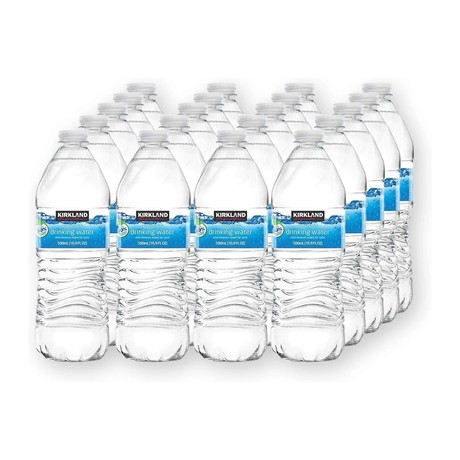
Purpose: cover your minimum drinking-water gap without a large storage footprint. 140 x 500ml bottles of natural spring water.
Inpress Plastics 5L Water Container
Drinking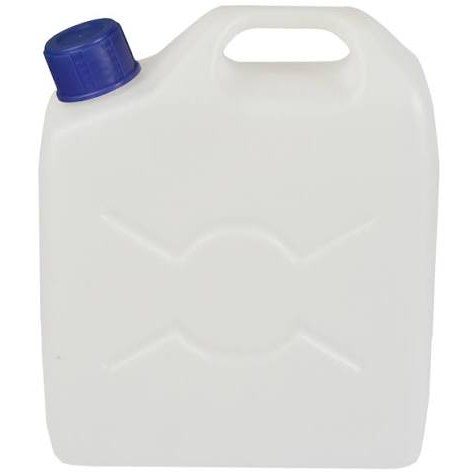
Purpose: efficient storage for larger gaps with limited cupboard space. Empty, refillable 5L container, food-quality polyethylene, rectangular shape for efficient stacking.
x10 Vira Safe Hand Sanitiser (500ml)
Hygiene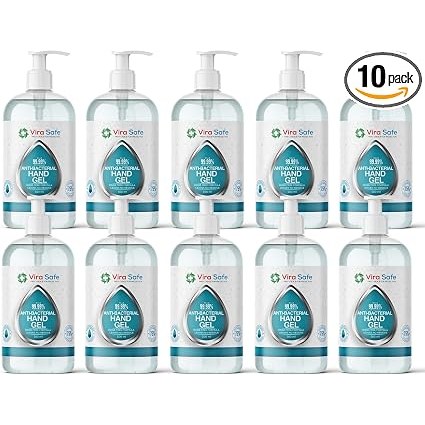
Purpose: basic hygiene cover when water is limited, per government guidance. 70% alcohol, UK-made, contains Vitamin E and Aloe Vera.